Argus Boats |
|||||||||||||
Argus Boats is a new boat building venture based in south east Queensland. The owners of Argus Boats as Outback Marine Australia Pty Ltd have been involved in the Australian marine industry for over 12 years supplying electrical, refrigeration and desalination equipment to the boating industry. For the past four years, the Panelec division has been manufacturing electrical panels, dash panels and distribution boards. Recently the online store shopOMA has begun marketing marine electrical, electronics and refrigeration products directly to the end user base. |
|||||||||||||
Project History and Objectives |
|||||||||||||
Our lifestyle in South East Queensland wasn't really a match for the beloved sail boat. The exploration of the Broad water, Moreton Bay and Hervey Bay was not really suited to a 1.8 metre draft and frankly we wanted a change from sailing because the time available to prepare and go did not give us a reasonable radius of operation. The sail boat was sold and replaced by an 18 year old 9.8 metre Cougar Cat. What a dramatic change. The boat was used as a refurbishment project with new electrical, dash, electronics and refrigeration fitted. The Cougar Cat demonstrated the exploration capability and freedom offered by shallow draft and a good turn of speed but the planing hull configuration had a poor range due to high fuel consumption (3.5 litres per nautical mile) and limited fuel carrying capability (400 litres). It was a great vessel for tooling around the broad water and southern Moreton Bay but we were looking for more. It came time to evaluate our needs for the future and see what alternatives were out there. We wanted a boat to enjoy while we were working and so it needed to easily support two and three day ventures with a reasonable turn of speed that would take us to places that were just not practical with a trawler style cruiser or planing diesel cruiser. It didn't need to be as fast as the Cougar Cat but we still wanted something that got along pretty well. And we wanted the range so that it wasn't out of the question to get up to Hervey Bay for a week or two. After laying out what we really wanted the search turned out to be somewhat elusive. Surprisingly there wasn't a real selection of vessels that came close to matching our needs. |
|||||||||||||
|
|||||||||||||
Realisation |
|||||||||||||
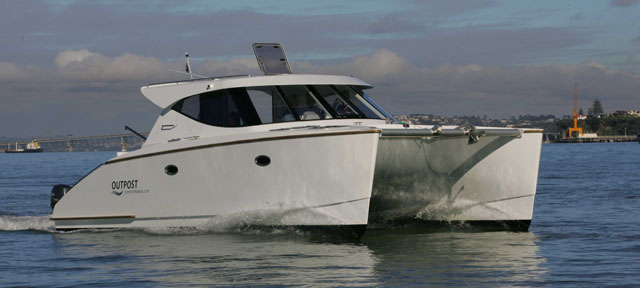
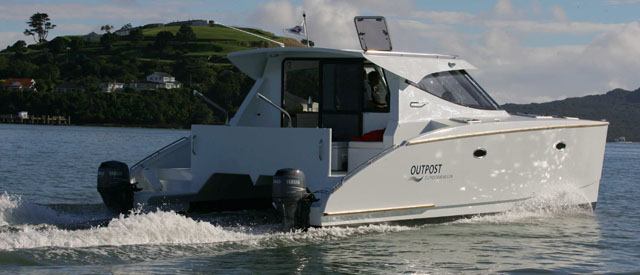
With a target budget in hand and a pretty good idea of what was wanted, we set out to find a vessel that would measure up to the job. There were several interesting concepts but only one stood out with the capability to tick all of the boxes. This was a 10.2 metre displacement catamaran design by the renowned New Zealand design firm Roger Hill Yacht Designs. Three examples of the design had been built to date.
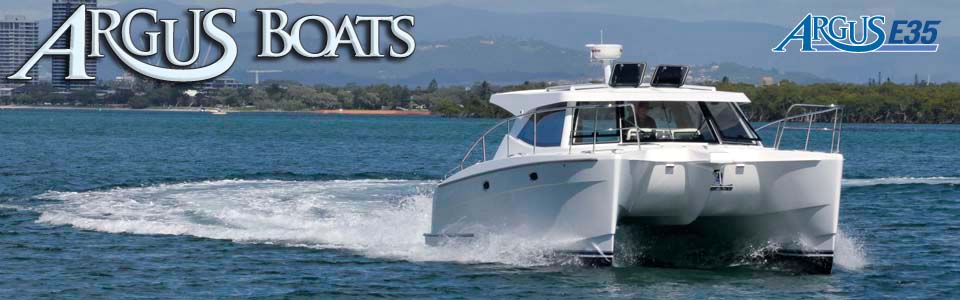
After flying to Auckland and going out on Shiraz (on a very rough day), we were convinced that this design had the potential. In a 30 knot headwind on the harbour, the vessel handled the ugly chop maintaining 12 knots square into it. The vessel space and layout was near perfect - we would probably like some more length in the aft deck. A follow up trip and a venture out on Outpost confirmed the original thoughts. Even at higher speeds the relatively low horsepower design presents a very low environmental impact. This can be seen by the virtually non existent wake. A higher percentage of engine power is translated into forward motion. Our main issue was that as a one-off custom design, the vessel could not meet the price structure offered by production moulded manufacture. The Argus E35 concept was developed as a fully molded construction production boat. Extensive composite tooling and advanced system engineering design would combine to produce a vessel that not only is more cost effective then the one-off counterpart but would have stylistic and functional features only achievable by a moulded design. The overall length was increased to 10.65 metres which along with some clever rearrangement added around 800 millimeters to the aft deck length. The helm area was redesigned to allow two people to sit together while underway. To reduce the heat load from the sun, the front glass was made more vertical and the brow was extended. A number of design enhancements were made throughout the development of the fully molded production boat. The design space arrangement took into account the system engineering requirement for a vessel that did not need a generator set yet could provide complete home comfort away from the dock. The Outback Marine experience has allowed the development of live aboard support systems that are second to none. The vessel is equipped at a level that is virtually ready to go for coastal cruising. |
Roger Hill 10M Displacement Powercat |